8kWh Solar Battery Backup System for Residential Energy Storage

- 9SUNSOLAR
- Xiamen,Fujian
- 7days(≤10pcs)
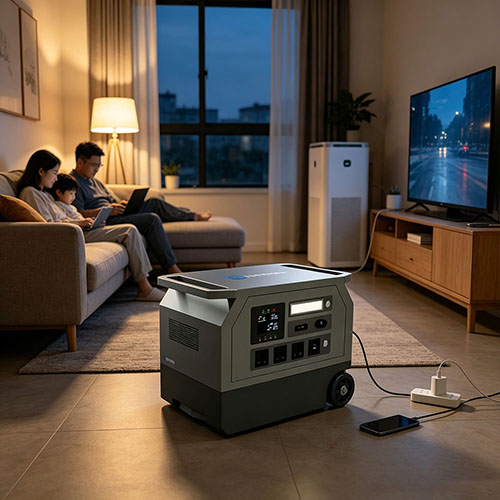
1.For the flat you don't own Renting rules out a wall-mounted battery: no drilling, no electrician, no permit, and nothing you have to uninstall when the lease ends. This one is 77.5kg on casters — it comes in through the door, plugs into an ordinary socket, and leaves with you. All it asks for is a bit of floor and a wall outlet.
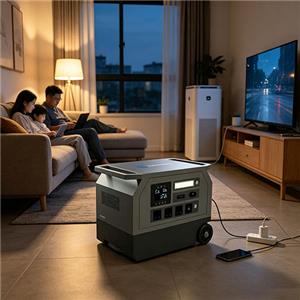
2.The workday the grid keeps interrupting Ten milliseconds is the number that matters when your income runs through a router. Calls don't drop, the NAS doesn't lose a write, the desktop doesn't restart mid-render. Eight kilowatt-hours carries a full day at a desk — laptop, monitor, router, second screen — with enough left to keep the fridge and the lights on until morning.
3.Three days of food, or one bad storm A fridge and freezer together pull roughly 300W on average, so the pack runs them for about 26 hours without you doing anything special, and longer if you keep the doors shut and the room cool. That is the difference between an outage that costs you an evening and one that costs you the contents of the freezer.
Description:
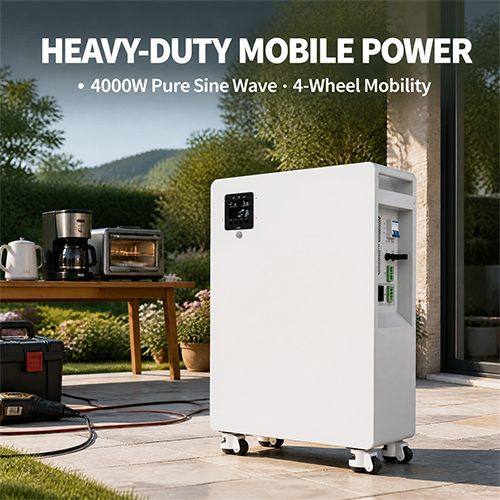
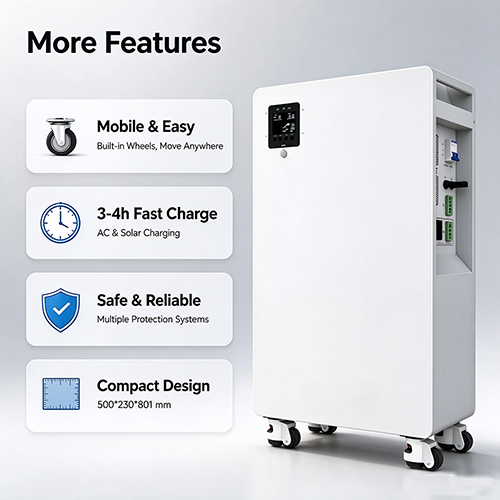
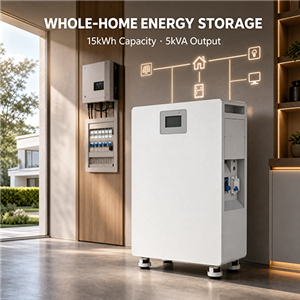
POWER 8 arrives assembled and rolls in on its casters. Same afternoon it can already be carrying your loads — no installer visit, no permit, no rack of separate boxes to wire together. It's an 8kWh solar battery backup system either way: a residential battery backup system with panels or without them.
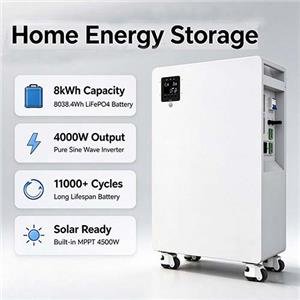
| Battery Capacity | 25.6V,8038.4W |
| Battery Type | Lithium Iron Phosphate(LiFePO₄), 8*314Ah |
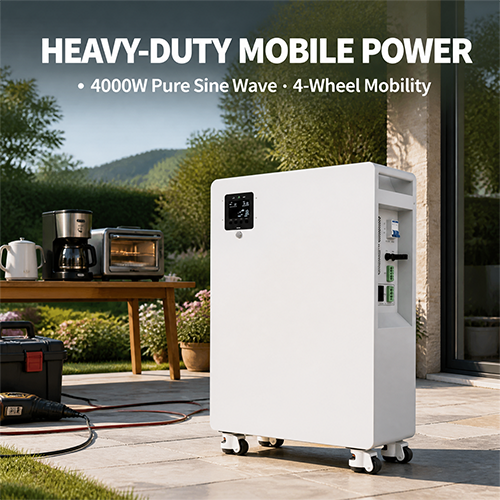
| Rated Power | 4000W, Pure Sine Wave |
| Rated Voltage | 230V, 50/60Hz |
| Mains Charging Time | 3~4 h |
| Protection Level | IP20 |
| Battery Cell Lifespan | 11000cycles@(25℃ ,100%D0D ,0.5P, @70%SOH) |
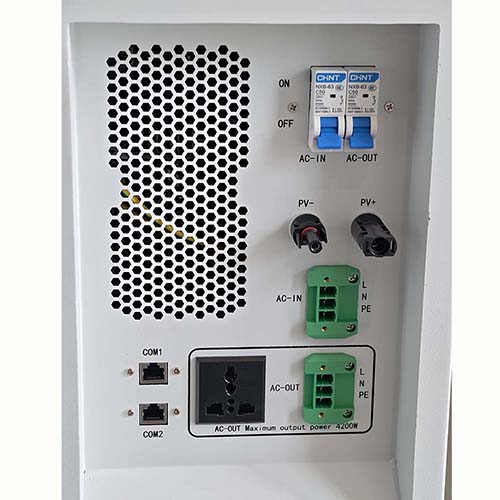
| Solar Input | Supports PV MPPT Tracking, DC 65-450V, Maximum Input Power 4500W |
| UPS Switching Time | 10ms (UPS bypass) 20ms (household appliances) |
Key Advantages:
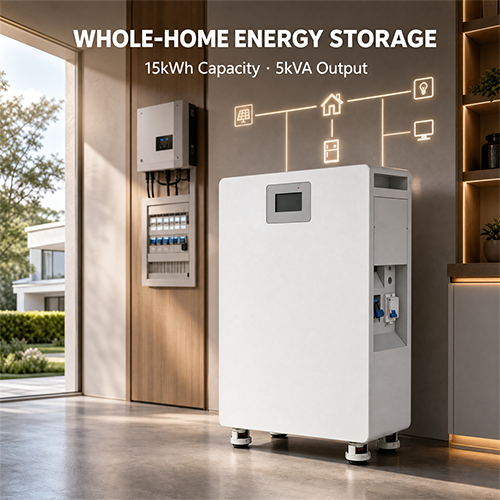
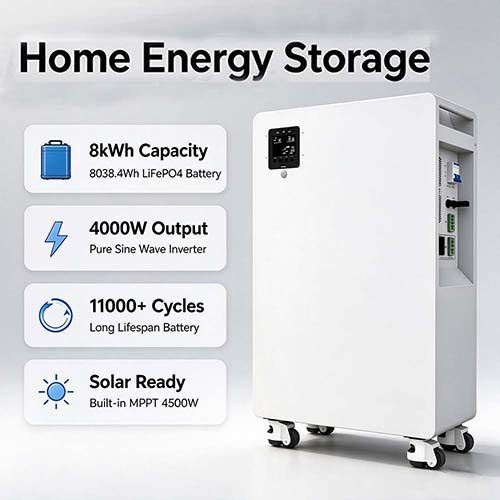
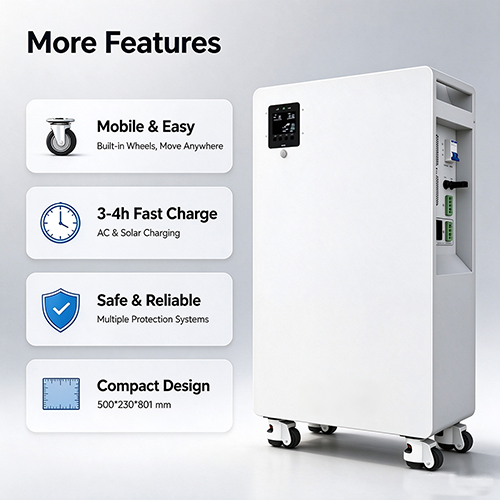
1.Nobody wants a solar project in their hallway. Battery, 4,000W inverter and MPPT charger sit together in one 500 × 230 × 801mm steel cabinet on casters, so there's no separate inverter to mount, no DC wiring between components and no conduit to pull. Your residential battery backup system is a power cable, plus one solar string if you have panels.
2.Start without panels if that's where you are. A home battery backup without solar still works: plug it into a wall outlet and the AC input (90–280V, up to 2,500W) refills the pack in 3–4 hours. Panels later? They land on the MPPT input, with no second charge controller and no reason to replace the box you already bought.
3.Sized for a house, not a campsite. Eight 314Ah LiFePO4 cells hold 8,038Wh — a fridge, freezer, lights, router and a workspace through the night: about 18 hours at 400W of essential load, roughly 7 at 1,000W of whole-home essentials. That's an 8kWh solar battery backup system earning its keep.
4.Transfer time is 10ms in UPS bypass mode and 20ms in home-load mode, so computers, NAS drives, routers, medical devices and controllers ride through an outage without restarting. That's the real test of emergency battery backup for home. Nothing beeps. Nothing reboots at 2am.
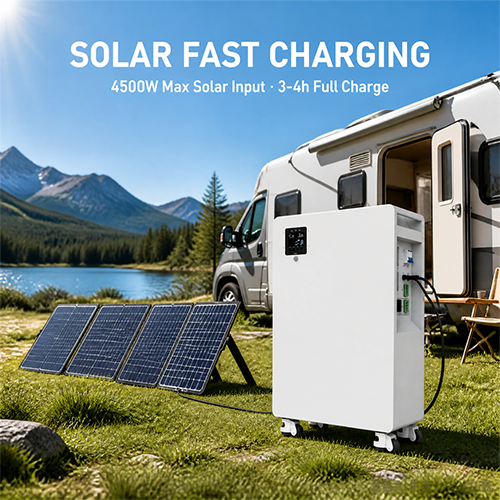
5.The MPPT tracker takes 65–450V DC at up to 4,500W, which covers a typical residential array on a single input, and brings a flat pack back in 3–4 hours of good sun. Daytime production goes into the battery instead of out to the grid at export rates.
6.There's a generator in this category, and it wants petrol, oil, a pull cord, a monthly test run and something to say about carbon monoxide. This doesn't. A home UPS battery backup that idles silently indoors at IP20, works from −20°C to 40°C on discharge, and carries six independent protection layers: input over/under-voltage, output overload and over-current, battery over/under-voltage, charge/discharge over-current, short circuit and over-temperature.
Factory:

Exhibition:

FAQ:
Q1: Do I need solar panels for the POWER 8 to work?
A1: No. Plug it into a wall socket and it draws up to 2,500W, topping the pack off in 3–4 hours. Panels are optional — the MPPT input is there whenever you want to add them.
Q2: Can I connect it to the solar panels I already have?
A2: Most likely, yes. Two numbers decide it: your string needs to sit somewhere between 65 and 450V, and the array can't exceed 4,500W. Inside those, it connects straight to the MPPT input with no extra charge controller. If your roof is laid out in an unusual way, have whoever installed the panels check the string figures first.
Q3: Will 8kWh run a fridge and freezer overnight?
A3: Yes, comfortably. The pair average 300–400W, which is about 18–20 hours on a full pack. A few lights, the router and some phones on top barely touch that.
Q4: How long does it take to recharge?
A4: 3–4 hours on grid at 2,500W, or 3–4 hours on solar at up to 4,500W. Some setups run both at once.