UzEnergy Expo 2026 Field Notes: What Central Asian Buyers Asked About Solar Mounting and EV Charging
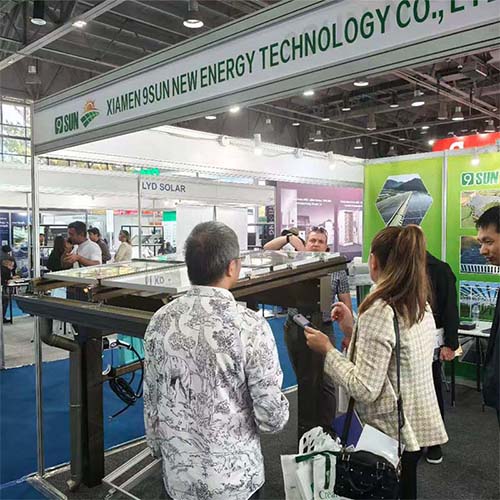
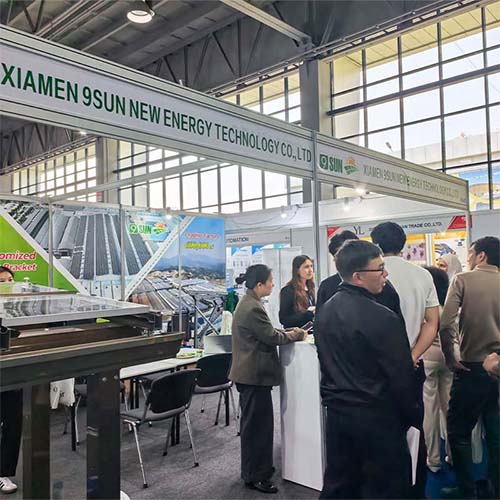
Three days at Uzexpocentre in Tashkent — Hall 1, Booth D04/1 — and one pattern showed up before the first afternoon was over. Visitors from Uzbekistan, Kazakhstan and the wider region were not opening with price per watt. They were opening with the site: how much dust, how much wind, how many microns of zinc, and how fast a truck can reach a project 600 km from the capital.
This is not a booth diary. It is a record of the questions that repeated across three days, because those questions describe what a solar project in Central Asia actually has to survive — and they are the same questions worth asking any solar mounting structure supplier, wherever the project sits.
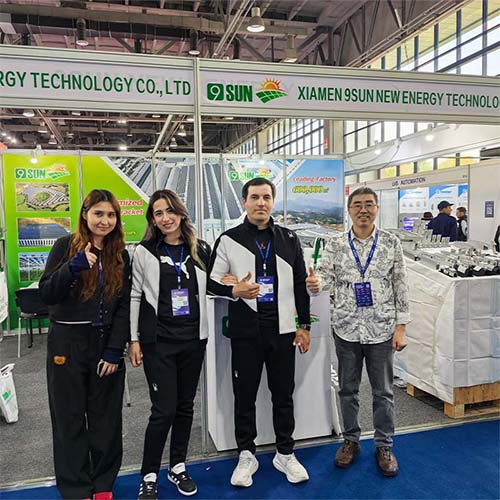
What we brought to Tashkent
The booth carried five product families, all from Xiamen 9SUN New Energy:
Ground mounting — adjustable-tilt structures on ground screws and concrete ballast, for sites where soil and frost depth decide the foundation.
Roof mounting — tile roof hooks, L-feet and standing-seam clamps for metal roofs, including non-penetrating clamp options.
PV carport — a single-row carport that shades the vehicle and generates above it, with the option to integrate EV charging per bay.
Rails, clamps and small parts — AL6005-T5 aluminium rails and SUS304 stainless clamps, plus the mid-clamps and end-clamps that decide whether an array stays aligned after two summers of thermal cycling.
EV charging — 7.4 kW, 11 kW and 22 kW Type 2 AC units, and a 30 kW DC fast charger in a single-gun configuration.
Site conditions set the agenda
Almost every technical conversation came back to three conditions.
Dust and heat. In summer, surface temperatures on dark anodised or painted components climb well above air temperature, and dust settles into every open profile. Buyers asked about drainage holes, closed-section versus open-section rails, and whether clamp hardware is stainless rather than coated steel.
Wind and snow load.Central Asian sites are not uniformly "high wind" or "high snow" — the conversation is always site-specific, and the answer has to come from a load calculation, not a brochure number. What buyers wanted was the input list: design wind speed, terrain category, roof height, snow zone, module dimensions and array tilt.
Corrosion budget. This was the single most repeated topic across all three days, and it is where cheap structures fail first.
The three questions that kept coming back
1. How many microns — and how many hours of salt spray?
Buyers have learned to ask for two numbers together. A galvanising thickness in microns and a salt-spray test duration in hours answer different questions: the first is what you can measure with a gauge on delivery, the second is what the coating survives in an accelerated chamber. A supplier who quotes only one of the two is usually quoting the flattering one.
The practical advice we gave at the booth: put both numbers in the purchase specification, agree the measurement points, and inspect with a coating gauge on arrival — not after installation.
2. Aluminium or hot-dip galvanised steel?
There is no universal answer, and the honest version is a trade-off list:
Aluminium (AL6005-T5) — lighter, no coating to damage on site, faster to install, better for roof work where every kilogram matters. Higher material cost, and it needs stainless hardware to avoid galvanic issues.
Hot-dip galvanised steel — lower material cost per kilogram and high stiffness for long spans, which suits ground mounts and carports. The coating is a wear surface: cuts and drilling at site have to be touched up, or corrosion starts at the wound.
For carports and large ground arrays, many buyers in the region ended up mixing the two — galvanised steel for the primary structure, aluminium rails and stainless clamps at the module interface.
3. Can you support an EPC tender?
This was the difference between a brochure conversation and a real one. What EPC contractors asked for, in roughly this order:
Structural drawings and load calculation inputs for the specific site
Datasheets with material grades, coating thickness and fastener specs
Packing lists and container loading plans, so site storage can be planned
Batch or heat-number traceability on galvanised parts
A realistic production and shipping lead time, in writing
Suppliers who could answer all five in the first meeting moved to sample requests. Suppliers who answered three did not.
Charging came up in the same conversation
The EV charger display sat next to the carport for a reason: in this region the two are increasingly bought together, and the buying logic is about dwell time and grid capacity rather than peak power alone.
22 kW AC per bay suits workplace, hotel and long-stay parking, where a car sits for hours and three-phase supply is available.
30 kW DC, single gun suits fleet yards and highway-adjacent sites where a vehicle needs a meaningful top-up in 30–40 minutes and the grid connection cannot support a larger cabinet.
Grid capacity decides the design. Where the service is small, the answer is load balancing across ports rather than a bigger breaker.
Software protocol matters before hardware. OCPP 1.6J and OCPP 2.0.1 are not interchangeable — an operator with an existing back office should confirm which version the charger speaks before ordering a fleet.
One clarification worth repeating, because it appeared in several conversations: IP54 means dust-protected and resistant to water splashes from any direction. It is not a waterproof rating, and outdoor installations still need a mounting position that avoids standing water and direct jet washing.
Where the market is heading
The demand side is not the constraint any more. Publicly reported figures put Uzbekistan's 2026 solar additions at around 2.8 GW, with a project pipeline several times that size and a national target that leans heavily on renewables by 2030. Panel supply has matured and priced itself into the plan; what now decides whether a project hits its commissioning date is the structure, the foundation and the delivery schedule.
That shift is visible at a trade fair. Two years ago the questions were about modules. This year they were about galvanising, load cases, container plans and lead times.
What happens next
If you are specifying a project in Uzbekistan or elsewhere in Central Asia, these four items let us answer properly instead of generically:
Site conditions — design wind speed, snow zone, roof type or soil report
Array layout — module size, rows, tilt angle, total kW
Coating and material requirement — microns, salt-spray hours, aluminium or steel
Delivery destination and required-on-site date
Send those and we will come back with a structure proposal, a drawing set and a shipping plan. For buyers who want to check the hardware first, sample clamps and rail sections can be shipped ahead of the order.
Thank you to everyone who stopped at Hall 1, Booth D04/1. The conversations were more useful than any catalogue.