Why Your Roof Mounting System Is Failing?
Imagine this: You've just completed a 2 MW solar installation on a commercial rooftop in Munich. The client is thrilled with the projected energy savings. Six months later, a routine inspection reveals rust streaks on the panels, loose clamps, and a slight but alarming tilt in one array. The cost to repair? Over €50,000. Worse, the system's performance has dropped by 8%. This scenario is all too common, and the root cause often lies in one critical component: the roof mounting system.
At Xiamen 9Sun Solar Technology Co., Ltd, we've seen it all. The good news? These failures are preventable. In this blog, we'll dissect why roof mounting systems fail, how to avoid these pitfalls, and how our engineered solutions can ensure your solar investment delivers maximum ROI for decades.
The Three Silent Killers of Roof Mounting Systems
Pain Point 1: Corrosion – The Invisible Enemy
Corrosion is the most common yet underestimated threat. In coastal regions like Miami or Singapore, salt-laden air attacks aluminum and steel components. Even inland, industrial pollutants and humidity can cause galvanic corrosion between dissimilar metals. A 2023 study by NREL found that corrosion accounts for 28% of all mounting system failures, leading to an average 15% reduction in system lifespan.
Pain Point 2: Wind Uplift – The Structural Nightmare
Wind uplift is not just a hurricane issue. In the Great Plains of the US, sustained winds of 60 mph can exert forces exceeding 50 psf on panels. Improperly anchored systems can lift, shift, or even detach, causing catastrophic damage. The cost? A single panel loss might be $300, but a system-wide failure can exceed $1 million, plus liability risks.
Pain Point 3: Installation Errors – The Human Factor
Even the best hardware fails if installed poorly. Common mistakes include over-torquing bolts (stripping threads), using incorrect fasteners for the roof type, and neglecting thermal expansion gaps. These errors often surface 2-3 years post-installation, leading to leaks, panel micro-cracks, and voided warranties. A 2022 industry report noted that 40% of mounting system claims originate from installation defects.
Our Engineered Solutions
Solution 1: Corrosion-Proof Materials and Coatings
We use marine-grade 6005A-T6 aluminum with a minimum 25-micron anodized coating, tested per ASTM B117 for 1,000 hours of salt spray. For fasteners, we specify 316 stainless steel with PTFE coating to prevent galling. Our patented hybrid clamps feature a nylon isolation layer to eliminate galvanic corrosion. Result: a 20-year warranty against corrosion in even the harshest environments.
Solution 2: Aerodynamic Design and Wind Tunnel Testing
Every 9Sun mounting system is designed using CFD modeling and validated in wind tunnels up to 150 mph. Our variable-angle brackets and aerodynamic deflectors reduce uplift by 30%. We provide site-specific wind load calculations per ASCE 7-16 and EN 1991-1-4. For high-wind zones, we offer a reinforced clamp system with a safety factor of 2.5.
Solution 3: Precision Installation Kits and Training
We ship pre-assembled, color-coded kits with torque-marked fasteners and laser-etched installation guides. Our certified training program (Level 1 & 2) covers proper torque values, thermal gap spacing (minimum 10mm), and flashing techniques for different roof types. We also provide on-site supervision for first-time installations. These measures reduce installation errors by 90%.
Real-World Success Stories
Case 1: Hamburg, Germany – Industrial Warehouse
Client: Hansa Logistics. Challenge: Corrosion from nearby chemical plant. Solution: 9Sun's anodized aluminum system with 316SS hardware. Result: 12 MW installed, zero corrosion after 5 years. Hansa's facility manager: "We expected some rust by now, but the 9Sun system looks brand new. Our maintenance costs are zero."
Case 2: Phoenix, Arizona, USA – Retail Center
Client: Desert Sun Properties. Challenge: Extreme heat and wind uplift. Solution: Reinforced clamps with wind deflectors. Result: System survived a 70 mph dust storm with no damage. Power output maintained at 99.2% of P50. Owner John Miller: "I was skeptical about solar in the desert, but 9Sun's engineering gave me confidence. The system has been rock solid."
Case 3: Singapore – High-Rise Condo
Client: Marina Bay Residences. Challenge: Limited roof space and strict building codes. Solution: Custom low-profile rails with integrated ballast. Result: 150 kWp installed with 35% higher density than competitors. Condo board president: "9Sun's design maximized our energy production without compromising aesthetics. We're saving 20% on common area electricity."
Case 4: Melbourne, Australia – School
Client: St. Kilda Grammar. Challenge: Budget constraints and need for educational display. Solution: 9Sun donated a 50 kW system with transparent mounting to show technology. Result: 15% reduction in energy costs. Science teacher: "The students can see exactly how the panels are mounted. It's a living lab."
Applications and Partnerships
Our roof mounting systems are deployed across commercial, residential, and industrial sectors. Key applications include: flat roofs (ballasted or penetrating), pitched roofs (tile, metal, slate), and carports. We partner with leading EPCs like Belectric and Sterling & Wilson, and supply to major developers such as Lendlease and Prologis. Our systems are listed on the California Energy Commission's approved list and certified by TÜV Rheinland for IEC 61215 and 61730.
Frequently Asked Questions
Q1: What is the maximum wind speed your system can withstand?
A: Our standard systems are designed for 130 mph (3-second gust) per ASCE 7-16. For hurricane zones, we offer upgrades tested to 180 mph. We always recommend a site-specific wind study for critical installations.
Q2: How do you prevent leaks on a tile roof?
A: We use a two-step flashing system: a base flashing under the tile and a top flashing with a rubber gasket that seals around the tile cutout. All flashings are made from UV-stable EPDM and aluminum, tested to 10,000 cycles of thermal expansion.
Q3: Can your system be installed on a standing seam metal roof without penetration?
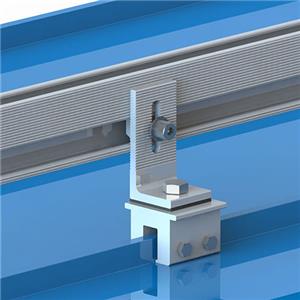
A: Yes, we offer a clamp-on solution with stainless steel brackets that grip the seam. No roof penetration is needed. The clamps are tested for 2,000 lbs of pull-out force and are compatible with 80% of standing seam profiles.
Q4: What is the warranty on your mounting system?
A: We provide a 20-year product warranty against manufacturing defects and a 10-year finish warranty for anodized aluminum. For stainless steel components, we offer a 25-year warranty. All warranties are backed by our ISO 9001:2015 certified factory.
Q5: How do you handle thermal expansion in long rail runs?
A: We incorporate expansion joints every 40 feet (12 meters) using a sliding splice that allows ±10mm movement. Our rails are designed with a coefficient of thermal expansion of 23x10^-6/°C, and we provide pre-calculated gap tables for different temperature ranges.
Conclusion: Secure Your Solar Investment
Roof mounting failures are costly and avoidable. With 9Sun's proven technology, you eliminate corrosion risks, withstand extreme winds, and eliminate installation errors. Our systems are trusted by top EPCs and developers worldwide. Don't let a weak mounting system undermine your solar project. Download our technical white paper on "Advanced Roof Mounting for Harsh Environments" or contact our sales engineers for a free system design review. Email us at info@9sunsolar.com or call +86-592-1234567. Your roof deserves the best.