How to Maximize Profit from Agricultural Solar Mounting Systems – A 2026 ROI Guide
The global solar farm market is expanding at a remarkable pace — from $140.94 billion in 2025 to $168.19 billion in 2026, representing a compound annual growth rate (CAGR) of 19.3%. By 2030, the market is expected to reach $349.03 billion. At the same time, **agrivoltaics** — the practice of combining solar power generation with agriculture on the same land — crossed a $5.5 billion global market in 2026, with roughly 18–20 GW of installed capacity worldwide.
For farmers, landowners, and investors, agricultural farmland solar mounting systems represent far more than an energy investment. They are a strategic asset that can generate dual income streams — electricity and agricultural produce — from a single parcel of land. But how do you actually maximize ROI? Here are the six critical dimensions that will determine whether your agrivoltaic solar farm thrives or underperforms in 2026.
1. Choose the Right Mounting System — Not All Systems Fit Every Farm
Agricultural solar mounting systems are not simply "ground-mount solar with taller posts." The system type you choose must align with your crops, your equipment, and your land-use goals. Here are the main configurations in commercial use today:
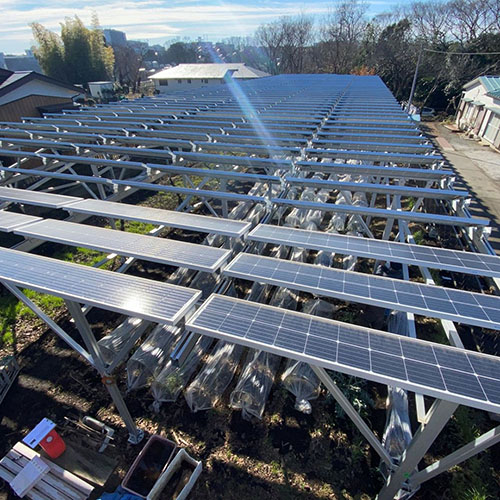
Elevated Agrivoltaic Systems (3–5 meters) : Panels are raised high enough to allow tractors, combines, and other large farm machinery to operate underneath. This is the most common configuration for row crops like wheat, corn, and soybeans.
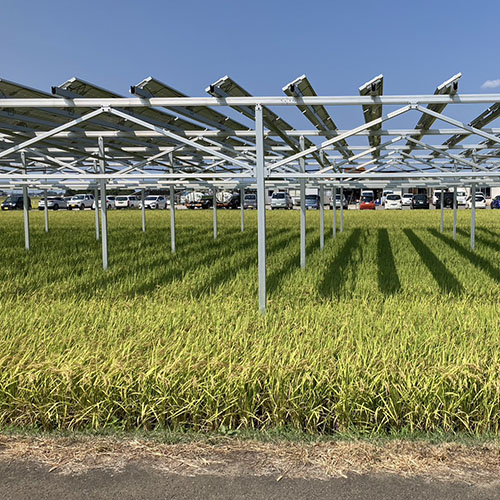
Standard 2.1-Meter Clearance Systems: The lowest-cost viable option for livestock grazing and mower access. In Germany's 15 MW Adorf project, cattle graze contentedly under panels mounted just over 2 meters high.
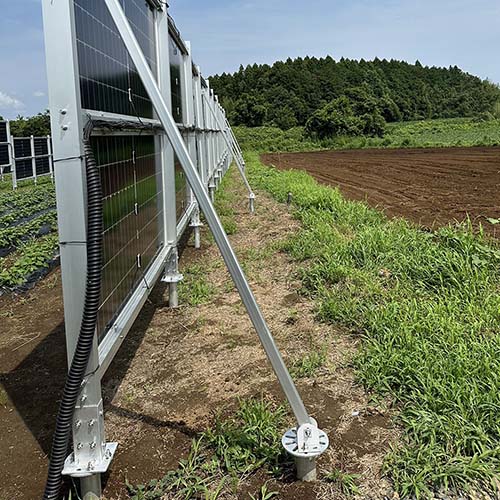
Vertical Bifacial Systems: Panels are mounted vertically in an east-west orientation, occupying only about 2% of the land area while leaving 98% available for agriculture. This configuration works well for orchards and pasture in high-insolation regions.
Ground-Level Agrivoltaics (1.1–1.5 meters) : A newer, cost-efficient approach developed by German engineering firm BEC Energie Consult. Structure costs range from just €0.03–0.04/W, with installed capacity of 1.3–1.6 MW per hectare. For a 5 MW project, substructure costs are approximately €200,000 — compared to €600,000 for a 2.1-meter system and €900,000 for a 4-meter design. This low-mounted design creates favorable microclimatic conditions for plant growth and is particularly effective for free-range poultry farming.
The Critical Decision: Your choice of agricultural solar mounting system determines not just energy yield, but whether your farm can continue operating as a farm. Choose wrong, and you may sacrifice crop yields, block equipment access, or both.
2. Optimize Design Parameters — The Art of Light-Sharing
The core challenge of agrivoltaics is light-sharing — balancing the solar panel's need for irradiance with the crop's need for photosynthesis. Here are the key design parameters that separate profitable systems from costly mistakes:
Ground Coverage Ratio (GCR) : Standard utility-scale solar farms typically run a GCR of 0.5–0.6. For agrivoltaic systems, you need to drop that to 0.2–0.3, with row spacing of 6–12 meters to accommodate tractors and combines. Yes, this reduces nameplate capacity — but it preserves your agricultural output, and that's where the dual-income math works.
Panel Clearance Height: Panel clearance typically ranges from 1.5 to 5.5 meters, depending on the equipment you need to run underneath. For combine-harvested cereals, panel density must stay below GCR 0.20 to avoid unacceptable yield losses.
Bifacial Modules: Double-glass bifacial modules paired with elevated mounting can capture reflected light from the ground below, boosting generation. These modules also degrade at only 0.3–0.5% per year — far better than conventional panels' 0.7% — extending your revenue window well beyond 30 years.
Single-Axis Tracking: The cheapest agrivoltaic system on a unit-cost basis is single-axis tracking, with a unit cost only 11% higher than ground-mounted PV. However, tracking adds complexity and maintenance costs — weigh this carefully against your specific site conditions.
The Fraunhofer ISE Heggelbach project in Germany achieved a Land Equivalent Ratio (LER) of 1.56–1.87 — meaning the same land produced the equivalent of 56–87% more combined agricultural and energy output than two separate mono-use systems could deliver. That is the ROI benchmark to aim for.
3. Understand the Real Costs — And the Real Returns
Agrivoltaic systems cost more than conventional ground-mount solar — typically 20 to 50% above standard ground-mount, with installed costs running $1.50 to $2.33 per watt. Capital costs in Europe and North America typically range from $1.2 to $2.0 million per installed megawatt, compared with $0.8 to $1.1 million for conventional solar farms.
But the revenue picture is entirely different:
Electricity Revenue: A 1 MW agrivoltaic system generates approximately €40,000–60,000 per year in electricity revenue, depending on local feed-in tariffs and irradiance.
Crop Revenue: With shade-tolerant crops like lettuce, berries, peppers, and herbs, yields often match or even exceed full-sun production in hot climates. For heat-sensitive crops, the partial shade from solar panels can reduce water stress and improve quality.
Land Lease Income: Solar developers typically sign 25- to 40-year leases, paying landowners $1,000 to $3,000 per acre annually. In Europe, land lease rates reach €800 to €2,500 per hectare per year. The national average solar land lease rate in the US for 2026 is roughly $500–$700 per acre, though high-demand states commonly reach $1,200–$2,500 per acre.
Sheep Grazing Income: Financial analysis of agrivoltaic sheep grazing shows EBITDA margins as high as 40% , far exceeding traditional farming returns. In optimized high-performance scenarios, the Auction Model can reach an ROI of up to 43%. ROI for breeding models ranges from 16% to 31%, while auction-based lamb operations show ROI potential of 22% to 43%.
The Payback Picture: Most farming clients achieve full ROI within 5–7 years, with many seeing positive cash flow much sooner.
4. Select the Right Crops — Not All Plants Thrive Under Panels
Crop selection is where many agrivoltaic projects succeed or fail. The data is now clear:
High-Compatibility Crops (yields match or increase): Lettuce, tomatoes, berries, peppers, herbs, and grazing pasture. In hot climates, the shade from solar panels can actually improve yields by reducing heat stress and water evaporation.
Moderate-Compatibility Crops: These require lower panel density (GCR below 0.20) and higher clearance. Field trials show wheat yields under and between panels decreased by 11.5% and 6.6% respectively compared to open-field controls.
Sheep Grazing: This is emerging as one of the most profitable agrivoltaic combinations. Sheep grazing under solar panels delivers dual revenue streams from livestock and solar site services, with ROI potential that outperforms conventional agriculture. In arid regions, shade from panels can increase available grass by up to 90%.
Key Principle: Design for the crop first, then optimize energy around it — not the other way around.
5. Leverage Policy Incentives — They Can Make or Break the Math
In 2026, agrivoltaics is entering its first true scale-up phase, with policy momentum accelerating across major markets:
Europe: Italy's incentive program is covering 1.04 GW by 2026, catalyzing farmer-led ventures rather than pure utility procurement. France followed with a 450 MW cooperative project driven by 35 growers. Germany operates under the DIN SPEC 91434 standard. Dedicated support schemes are now taking shape in France, Italy, Germany, Spain, and emerging Central European markets.
United States: The DOE's SolWEB2 funding opportunity will award up to $11 million** for research and development, with individual awards ranging from **$1 million to $3 million. Colorado's Agrivoltaics Research and Demonstration Grant program is accepting applications for FY 2026-27 through June 15, 2026. New York State is actively developing an agrivoltaics incentive program. The Center for Rural Affairs released a fact sheet in June 2026 examining how land-use tax policy can encourage simultaneous use of land for solar development and agriculture.
India: PM-KUSUM 2.0 is expected to give a bigger push to agri-PV as the current phase concludes in March 2026.
UK: The government closely follows agrivoltaics developments and supports innovative technologies through UK Research and Innovation initiatives.
Action Step: Research local incentives before you design your system. Many programs require specific design parameters (minimum clearance, maximum GCR, crop types) to qualify — and designing for compliance from the start is far cheaper than retrofitting later.
6. Avoid the Hidden Risks — What's in Your Contract Matters
The highest-risk areas in 2026 agrivoltaic projects center on operational responsibility and performance guarantees. These three clauses must be in every contract:
① Degradation Guarantees: If module degradation exceeds 0.45% per year, the supplier compensates you for the lost generation.
② Response Times: If structural damage occurs (e.g., panel breakage from hail or wind), the installer must respond within 2 hours and complete replacement within 48 hours. Delays mean lost revenue — and dead crops.
③ System Downtime Penalties: If the smart control system goes down for more than 2 hours, the operator pays 200% of the crop value lost during that period.
Land-Use Compliance: In 2026, many jurisdictions have tightened rules around solar farms on agricultural land. Some bills threaten to narrow federal funding for solar projects on farmland. Others are requiring minimum clearance heights and crop activity to qualify as "agrivoltaic" rather than simply "solar on farmland." Do your land-use due diligence before signing anything.
Conclusion: The ROI Is in the Integrated Math
Agricultural farmland solar mounting systems are not about "slapping panels on poles and collecting a check." They are about land-asset optimization — turning a single hectare into a dual-income producer.
The global agrivoltaics market is expected to grow at 10.8–11.5% CAGR through 2030, with installed capacity projected to reach 35–40 GW. The solar farm market overall is on track for $349 billion by 2030. In this rapidly expanding landscape, those who choose the right system, optimize design, select compatible crops, leverage incentives, and structure smart contracts will capture the disproportionate returns.
One piece of land. Two income streams. Farming continues — and so does the revenue.