
Ballasted Roof Mounting System: The No-Drill Way to Solarize a Flat Roof
A ballasted roof mounting system holds a solar array down with weight instead of bolts. On a flat or low-slope commercial roof, that means no drilling through the waterproof membrane, no leak risk and no voided roofing warranty. For warehouses, factories, logistics centres and retail buildings, ballasted solar racking is often the fastest and lowest-risk way to add PV capacity.
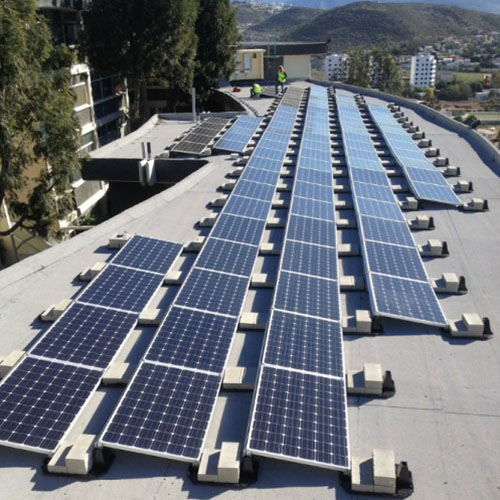
Why Flat Roofs Choose Ballasted Solar Racking
Traditional rail-and-bracket mounting depends on roof penetrations, and every hole is a future leak path. Non-penetrating solar mounting removes that risk entirely: the array rests on protective pads, and ballast trays carry the uplift load. Installation is quicker because there is no flashing, no sealant cure time and no hot work. The layout also stays flexible — rows can be adjusted, extended or removed when the roof is serviced or the building changes use.
What a Complete Ballasted Roof Mounting System Includes
A properly engineered kit is more than a tray and a block:
Pre-assembled ballast trays sized to the wind and roof load
Corrosion-resistant aluminium rails and mid/end clamps
EPDM protective pads at every membrane contact point
Optional wind deflectors for exposed edges and corners
Bonding clips and cable management for a clean, code-compliant array
Matching these parts as one system matters. Mixing trays, rails and clamps from different suppliers is where ballast calculations and warranties usually break down.
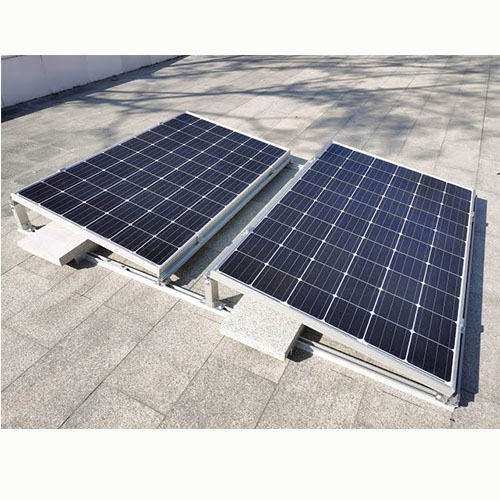
Where Ballasted Roof Mounts Work Best
Commercial flat roof solar is the core application: warehouses, manufacturing plants, cold stores and shopping centres with concrete decks or membrane roofs such as TPO, PVC and EPDM. The system suits low-slope roofs where penetrations are restricted, where the membrane is still under warranty, or where the building owner wants a reversible installation. Roofs with very light structure or extreme wind exposure may need a hybrid design with mechanical restraint at the perimeter.
Five Checks Before You Specify a Ballasted System
Roof load capacity — confirm the deck can carry modules, rails, trays and ballast, checked at beams and columns rather than as a roof-wide average.
Wind uplift — design wind speed, building height, terrain and parapet height set the ballast weight per zone.
Membrane and drainage — protect every contact point and keep water paths to the outlets clear.
Module compatibility — clamp range, module thickness and snow load must match the rail and tray spacing.
Maintenance access — leave walkways and keep HVAC units, skylights and outlets reachable.
Lower Installed Cost, Faster Commissioning
Because flat roof solar racking arrives pre-assembled, crews spend less time on site. There is no flashing, no membrane repair and no waiting on sealants, so a ballasted array can be commissioned in a fraction of the time of a penetrated system. Ballast blocks are usually sourced locally, which keeps freight costs down, and the non-penetrating design simplifies roof inspections and future membrane repairs.
Design Your Ballasted Roof Mount with 9Sunsolar
9Sunsolar supplies complete ballasted roof mounting systems with pre-assembled trays, aluminium rails, clamps, protective pads and wind deflectors. Send us your roof drawing, parapet height, design wind speed, module size and available roof load, and our engineers will return a layout with a per-zone ballast schedule and bill of materials.